
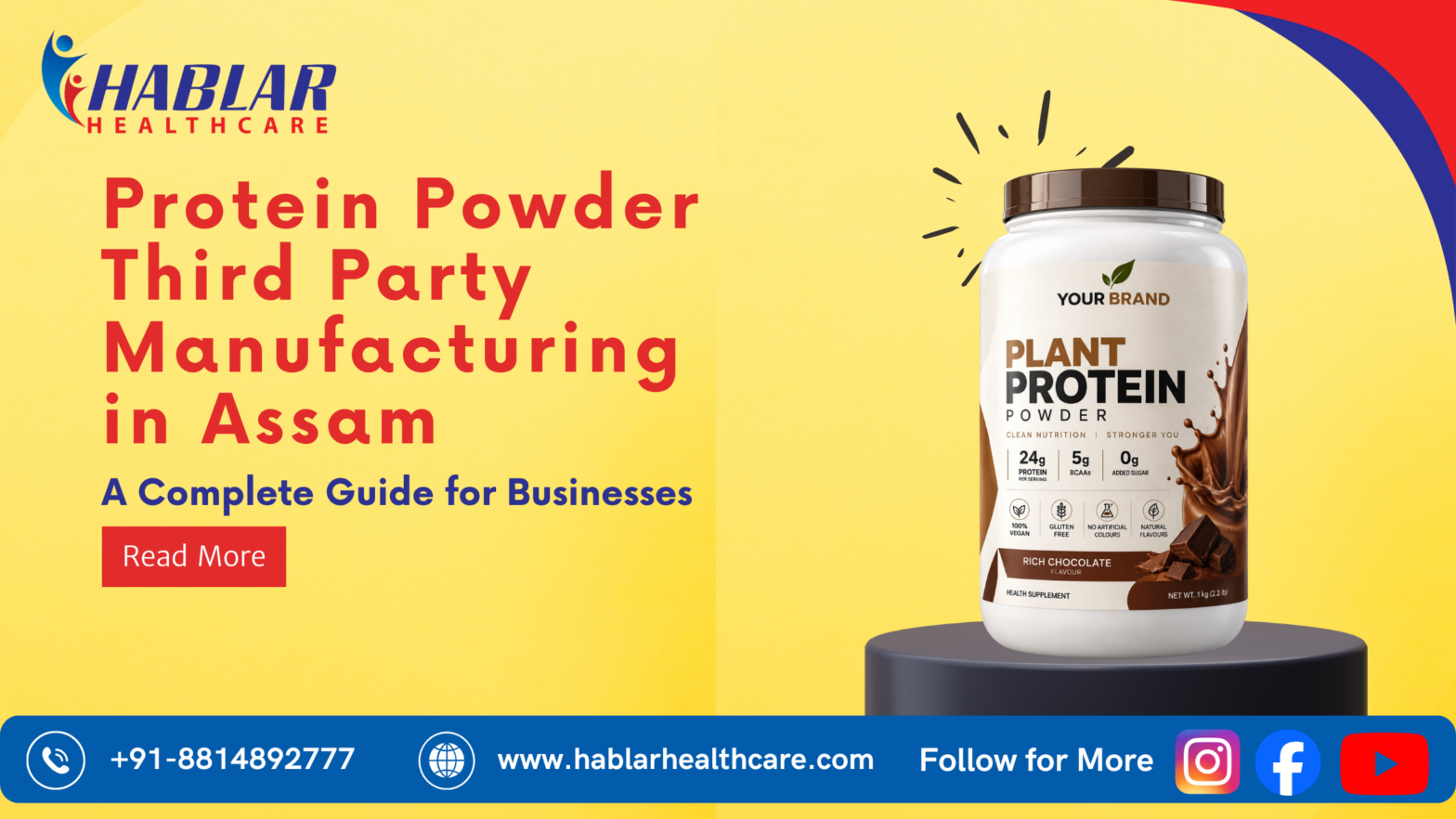
The demand for protein-based nutritional products has created opportunities for businesses looking to enter or expand within India’s nutrition and wellness market. For entrepreneurs and established businesses in Assam, protein powder third party manufacturing in Assam can be a practical option for developing a private label or branded nutritional supplement range without independently establishing a complete manufacturing facility.
From sports nutrition and fitness supplements to everyday nutritional products, protein powders have become an important category for brands serving different consumer requirements.
By partnering with a suitable contract manufacturer, businesses can explore product formulation, ingredient selection, packaging, quality testing, and brand development under an agreed manufacturing arrangement.
However, selecting a manufacturing partner requires careful consideration of product quality, regulatory compliance, production capabilities, minimum order quantities, and commercial terms.
This guide explains how third-party protein powder manufacturing works, which product categories businesses can explore, how to select a manufacturer, and what to consider before launching a protein powder brand in Assam.
Understanding Protein Powder Third Party Manufacturing in Assam
Protein powder third-party manufacturing is a business arrangement in which a company contracts an external manufacturer to produce protein-based nutritional products.
The products may be marketed under the contracting company’s brand, provided the relevant regulatory requirements are met.
This arrangement can be suitable for:
- Entrepreneurs planning to launch a protein powder brand.
- Fitness and nutrition businesses expanding their product portfolios.
- Nutraceutical distributors exploring private label opportunities.
- E-commerce businesses interested in branded nutritional supplements.
- Established healthcare and wellness companies seeking additional manufacturing capacity.
- Businesses looking to develop specialised protein formulations.
Companies in Assam can explore manufacturing partnerships with suitable facilities located within or outside the state. The manufacturer’s location should be evaluated alongside its licences, capabilities, quality systems, production capacity, and logistics arrangements.
A manufacturer does not need to be physically located in Assam to serve a business operating there. However, actual service availability, transportation arrangements, and delivery timelines should always be confirmed.
Why Is Protein Powder Third Party Manufacturing in Assam an Option for Businesses in Assam?
Launching a nutritional supplement brand involves several activities beyond simply selecting a product and printing a label.
Businesses need to consider ingredients, formulation requirements, packaging, quality assurance, regulatory responsibilities, distribution, and customer support.
Third-party manufacturing may help businesses organise these activities through an external production partner:
1. Reduced Need for Manufacturing Infrastructure
Setting up a dedicated manufacturing facility requires investment in equipment, premises, qualified personnel, quality systems, and regulatory compliance.
Working with an authorised third-party manufacturer may allow a business to access existing production infrastructure rather than establishing its own facility.
The financial and operational benefits depend on the manufacturing agreement, product requirements, and the responsibilities retained by the brand owner.
2. Opportunities for Private Label Branding
Protein powder third party manufacturing in Assam can allow businesses to market eligible protein powder products under their own brand names.
Depending on the manufacturer’s capabilities and the agreement, businesses may be able to select:
- Product type and formulation.
- Flavour options.
- Pack sizes.
- Packaging formats.
- Brand identity and label design.
- Product positioning and target market.
All formulations, product names, nutritional claims, and labels must comply with the applicable regulations.
3. Access to Existing Manufacturing Capabilities
An established manufacturer may already have blending, filling, packaging, and quality-control infrastructure appropriate for particular nutritional products.
Businesses should verify that the facility is authorised and technically capable of producing the specific protein formulation they require.
The presence of equipment alone does not establish regulatory approval or suitability for every product category.
4. Opportunities to Expand Product Portfolios
Businesses already involved in wellness, nutrition, healthcare, or distribution may consider adding protein powders to their existing portfolios.
Depending on the manufacturer’s approved scope, a business may explore different formulations and pack sizes to serve its intended customers.
A gradual product launch can help businesses evaluate operational requirements and customer response before expanding their range.
Types of Protein Powder Products Businesses Can Explore
Protein powder manufacturing can involve different protein sources, nutritional compositions, flavours, and product formats.
The available options depend on ingredient suitability, manufacturing capability, product classification, and regulatory permissions.
1. Whey Protein Powder
Whey protein is derived from milk and is commonly used in sports nutrition and other protein supplement formulations.
Businesses may explore different whey-based formulations, subject to ingredient availability and applicable requirements.
Potential formulation considerations include:
- Whey protein concentrate.
- Whey protein isolate.
- Protein blends containing permitted ingredients.
- Flavoured and unflavoured products.
The exact protein content, ingredient composition, and nutritional profile must be established through the formulation and verified through appropriate testing.
2. Plant-Based Protein Powder
Plant-based protein powders may be developed using suitable plant protein sources.
Depending on the formulation, potential ingredients may include permitted sources such as pea protein, soy protein, or other eligible plant proteins.
Businesses considering plant-based formulations should evaluate:
- Protein content and nutritional composition.
- Ingredient quality and sourcing.
- Flavour and texture.
- Solubility and mixing characteristics.
- Allergen declarations.
- Product stability and packaging requirements.
Any ingredient used must be permitted for the intended product category and comply with applicable food regulations.
3. Protein Blends
Protein blends combine two or more protein sources in a single formulation.
A manufacturer may be able to develop a blend according to the business’s product specifications, subject to ingredient permissions and technical feasibility.
The suitability of a blend depends on its intended nutritional purpose, ingredient compatibility, taste, texture, and verified nutritional composition.
4. Flavoured Protein Powder
Flavour selection can influence a product’s consumer appeal and market positioning.
Depending on the formulation and available ingredients, businesses may explore flavours such as:
- Chocolate.
- Vanilla.
- Strawberry.
- Mango.
- Coffee.
- Other suitable flavour profiles.
The final flavour options should be confirmed with the manufacturer. Any flavours, sweeteners, colours, and other additives must be permitted for the applicable product category.
5. Specialised Nutritional Protein Formulations
Some businesses may be interested in protein formulations designed for particular nutritional requirements.
Such products require careful formulation, substantiation of claims, and confirmation of their correct regulatory classification.
Products must not be marketed with unsupported disease-treatment or prevention claims.
Third Party Protein Powder Manufacturing Services
The exact services offered by a manufacturer vary. Businesses should request a detailed description of the services included in the proposed arrangement.
Product Formulation and Development
Formulation development involves establishing the product’s composition, ingredient quantities, nutritional specifications, and relevant technical characteristics.
A business should communicate its product requirements clearly, including:
- Intended product category.
- Protein source.
- Target nutritional composition.
- Desired flavour.
- Sweetener preferences.
- Serving size.
- Packaging requirements.
- Proposed product positioning.
The manufacturer should assess whether the proposed formulation is technically feasible and compliant with applicable regulations.
Ingredient Sourcing
Ingredient sourcing involves selecting suitable raw materials for production.
Businesses should ask about supplier qualification, ingredient specifications, traceability, and the documentation available for relevant raw materials.
Where necessary, request information about allergen controls and the handling of ingredients that require special precautions.
Blending and Production
Protein powder production may involve weighing, blending, processing, and filling activities appropriate to the formulation.
Manufacturing procedures should be designed to maintain product consistency and prevent contamination.
The specific process depends on the protein source, formulation, equipment, and manufacturing facility.
Packaging and Labelling
Packaging protects the product and provides important information to consumers.
Depending on the manufacturer’s capabilities, packaging options may include:
- Jars and containers.
- Food-grade pouches.
- Sachets.
- Other suitable packaging formats.
Packaging materials must be appropriate for the product and comply with applicable requirements.
Labels should accurately communicate the product’s identity, ingredients, nutritional information, allergens, serving instructions, storage conditions, and other mandatory declarations.
Quality Testing and Documentation
Quality assurance is an essential part of nutritional supplement manufacturing.
Businesses should discuss the testing and documentation required for their products, which may include:
- Nutritional composition testing.
- Protein content verification.
- Microbiological testing.
- Relevant contaminant testing.
- Ingredient and finished-product specifications.
- Batch identification and traceability.
- Shelf-life and stability information, as applicable.
Testing requirements should be established according to the product’s composition, applicable standards, and risk profile.
How to Choose a Protein Powder Manufacturer for Your Assam Business
Selecting a suitable manufacturer is an important step in developing a protein powder brand.
Rather than relying only on quotations or promotional claims, businesses should assess the following factors.
1. Verify Licences and Regulatory Compliance
Ask for the manufacturer’s applicable food business licence and confirm that its authorised activities cover the proposed product.
Protein powders may fall under different regulatory categories depending on their composition, intended use, and claims.
Verify that the ingredients, formulation, and product category are permitted under the applicable requirements.
2. Review Manufacturing Capabilities
Confirm whether the manufacturer can produce your specific formulation.
Ask about its equipment, production capacity, available packaging formats, ingredient-handling procedures, and experience with comparable products.
Do not assume that every manufacturer offering nutritional supplements can produce every type of protein powder.
3. Evaluate Quality-Control Procedures
Request information about quality assurance, raw material checks, production controls, finished-product testing, and batch documentation.
Where appropriate, review available certificates of analysis and relevant quality records.
Quality documentation should correspond to the actual product and manufacturing facility.
4. Compare Minimum Order Quantities
Minimum order quantities can vary according to the ingredients, formulation, packaging, production process, and manufacturer.
Before proceeding, request a written quotation that specifies:
- Minimum order quantity.
- Price per unit.
- Packaging and labelling charges.
- Applicable taxes.
- Testing or development charges.
- Payment terms.
- Production lead time.
- Dispatch and transportation costs.
This information can help businesses estimate their initial investment and working capital requirements.
5. Assess Packaging and Customisation Options
If you intend to establish a distinctive brand, discuss available packaging formats, label specifications, printing options, and customisation requirements.
Confirm which services are included in the quoted price and which may involve additional costs.
All customisation must remain consistent with the product’s approved composition and regulatory requirements.
6. Understand Supply and Delivery Arrangements
For a business operating in Assam, transportation and inventory planning deserve particular attention.
Discuss the proposed dispatch location, transportation method, estimated delivery timeline, handling requirements, and responsibility for transit-related issues.
For products sensitive to moisture, temperature, or other environmental conditions, confirm that suitable storage and transportation arrangements are available.
7. Review the Manufacturing Agreement
A written agreement should define the responsibilities of the manufacturer and the brand owner.
Important areas include:
- Product specifications.
- Ingredient and formulation requirements.
- Quality standards.
- Testing and documentation.
- Packaging and labelling responsibilities.
- Regulatory obligations.
- Pricing and payment conditions.
- Minimum order quantities.
- Delivery timelines.
- Product complaints and quality-related procedures.
- Confidentiality and ownership of relevant intellectual property.
A clear agreement can reduce misunderstandings and support a more organised manufacturing relationship.
How to Start Your Own Protein Powder Brand in Assam
Launching a protein powder brand involves product planning, regulatory checks, manufacturing coordination, and commercial preparation.
The following steps provide a practical starting point.
Step 1: Research Your Target Market
Identify the customers you intend to serve.
Your research may consider fitness centres, sports nutrition retailers, online consumers, nutrition businesses, and other relevant distribution channels.
Avoid assuming that all customers have the same preferences. Product format, flavour, price, and nutritional requirements may vary across different market segments.
Step 2: Select Your Product Category
Decide whether you want to explore whey protein, plant-based protein, a protein blend, or another suitable formulation.
Consider the product’s intended use, ingredient requirements, target price, and manufacturing feasibility.
Step 3: Prepare Your Product Specifications
Create a written brief containing the proposed ingredients, nutritional profile, flavour, pack size, packaging type, and expected order quantity.
A clear specification makes it easier for manufacturers to assess the project and provide comparable quotations.
Step 4: Shortlist Suitable Manufacturers
Contact manufacturers whose licences, facilities, and product capabilities match your requirements.
Request relevant documentation and clarify which services they provide.
Step 5: Review Samples and Product Specifications
Where samples are available, evaluate the product’s taste, texture, mixing characteristics, and other relevant attributes.
Samples should be assessed alongside the proposed formulation and quality documentation.
Do not treat a sample’s appearance or taste as a substitute for appropriate safety and quality testing.
Step 6: Finalise Regulatory and Label Requirements
Determine the correct regulatory classification of the product and identify the applicable requirements.
Review ingredient permissions, nutritional declarations, claims, allergen statements, and other mandatory label information before commercial production.
Step 7: Confirm Commercial Terms
Review the quotation, minimum order quantity, payment schedule, production timeline, packaging costs, and delivery arrangements.
Make sure the agreement clearly identifies each party’s responsibilities.
Step 8: Plan Distribution and Marketing
Develop a distribution plan based on the channels you intend to use.
Potential channels may include eligible retail outlets, authorised distributors, fitness-related businesses, and e-commerce platforms.
Marketing content should accurately describe the product and avoid unsupported health, performance, or disease-related claims.
Regulatory Compliance for Protein Powder Manufacturing in India
Regulatory compliance should be considered from the beginning of the product development process.
Protein powders marketed as foods, health supplements, or nutraceuticals must comply with the requirements applicable to their specific classification.
The relevant rules may cover ingredients, permitted additives, manufacturing practices, labelling, claims, testing, and licensing.
The Food Safety and Standards Authority of India (FSSAI) provides regulatory information and licensing resources for food businesses.
Businesses obtaining products through third-party manufacturing should also determine the licence category and responsibilities applicable to their own activities, including whether a relabeller licence is required.
The applicable requirements should be verified before production and sale because the correct regulatory treatment depends on the product and business arrangement.
Important Labelling Considerations
Depending on the product classification and applicable rules, labels may need to include:
- Name and category of the food.
- Ingredient list.
- Nutritional information.
- Allergen declarations.
- Net quantity.
- Serving instructions, where applicable.
- Storage instructions.
- Batch or lot identification.
- Date marking and shelf-life information.
- Manufacturer and brand-owner details, as applicable.
- FSSAI licence details, where required.
- Mandatory warnings, declarations, or disclaimers.
The final label should be reviewed for compliance before the product is released for sale.
Responsible Product Claims
Protein powder marketing should focus on accurate, substantiated information.
Businesses should not make unsupported claims that a product cures, treats, or prevents diseases or guarantees particular body-composition or athletic outcomes.
Claims relating to protein content, nutritional benefits, or other product characteristics should be supported by appropriate evidence and comply with the applicable advertising and labelling regulations.
Protein Powder Manufacturing Opportunities Across Assam
Businesses may explore protein powder distribution and brand development opportunities in different parts of Assam.
Potential commercial areas include:
- Guwahati.
- Dibrugarh.
- Silchar.
- Jorhat.
- Tinsukia.
- Tezpur.
- Nagaon.
- Sivasagar.
- Goalpara.
- Bongaigaon.
These are potential areas for market research and business development. Their inclusion does not mean that a particular manufacturer operates a facility or maintains a distributor in each location.
Before planning distribution, businesses should assess local demand, competition, transportation costs, customer preferences, and the applicable licensing requirements.
Frequently Asked Questions (FAQs)
1. What is protein powder third-party manufacturing in Assam?
Protein powder third-party manufacturing is an arrangement in which a business contracts an external manufacturer to produce protein-based nutritional products. A business operating in Assam may explore suitable manufacturers in the state or elsewhere in India, subject to the relevant licences, product requirements, and commercial terms.
2. Can I launch my own protein powder brand in Assam?
Yes, launching a protein powder brand may be possible through an appropriate manufacturing arrangement. You must ensure that the product, ingredients, labelling, claims, and business activities comply with the applicable regulatory requirements.
3. What types of protein powders can be manufactured through third-party manufacturing?
Depending on the manufacturer’s capabilities and regulatory permissions, options may include whey-based protein powders, plant-based protein powders, protein blends, and selected flavoured formulations. Confirm the availability and compliance of each proposed product.
4. Is third-party protein powder manufacturing suitable for startups?
It may be suitable for startups that want to introduce nutritional products without independently establishing a manufacturing facility. Startups should carefully evaluate minimum order quantities, development costs, regulatory responsibilities, working capital, and distribution plans.
5. Can I customise the flavour of my protein powder?
Customisation may be possible depending on the manufacturer’s formulation capabilities and available ingredients. Flavouring ingredients and additives must be suitable for the product and permitted under the applicable regulations.
6. What packaging options are available for protein powder?
Depending on the manufacturer, packaging options may include jars, containers, pouches, and sachets. The selected packaging must be appropriate for the formulation and comply with applicable packaging requirements.
7. What is the minimum order quantity for protein powder manufacturing?
There is no single minimum order quantity applicable to every manufacturer. It depends on the formulation, ingredients, packaging, batch size, and production arrangements. Request a written quotation for your specific requirements.
8. How much does third-party protein powder manufacturing cost?
The cost varies according to protein source, ingredient quality, nutritional composition, flavour, packaging, order quantity, testing, and transportation. A manufacturer can provide a more meaningful estimate after reviewing your product specifications.
9. Do I need an FSSAI licence to sell my own protein powder brand?
Food businesses must comply with the applicable FSSAI licensing and registration requirements. The licence category depends on the business activity and product arrangement. Businesses using third-party pharma manufacturing should verify the requirements applicable to their own role, including relabelling where relevant.
10. How can I check whether a protein powder manufacturer is reliable?
Review its applicable licences, manufacturing capabilities, quality-control systems, product documentation, testing arrangements, commercial terms, and references where available. Verify that the documentation covers the actual facility and proposed product.
11. Can a manufacturer outside Assam supply protein powder to my business?
A manufacturer located outside Assam may be able to supply your business, provided the relevant regulatory, contractual, and distribution requirements are met. Confirm dispatch arrangements, delivery timelines, transportation costs, and product-handling conditions.
12. Can I sell private label protein powder online?
Online sales may be possible if the business and product comply with applicable food regulations, labelling requirements, e-commerce obligations, and platform policies. Product claims and advertising should accurately represent the product.
Conclusion
Protein powder third party manufacturing in Assam offers a potential route for entrepreneurs, distributors, and established businesses interested in developing their own nutritional supplement brands.
By working with a suitable manufacturing partner, businesses can explore protein formulations, ingredient options, packaging, and production arrangements without necessarily establishing their own manufacturing infrastructure.
However, a successful manufacturing relationship requires more than selecting a product. Businesses should verify licences, evaluate quality systems, confirm product specifications, understand commercial terms, and address regulatory responsibilities before launching their products.
Whether you are planning a whey protein product, a plant-based formulation, or a broader nutritional supplement portfolio, careful research and practical planning can help you make informed decisions about your manufacturing project.