
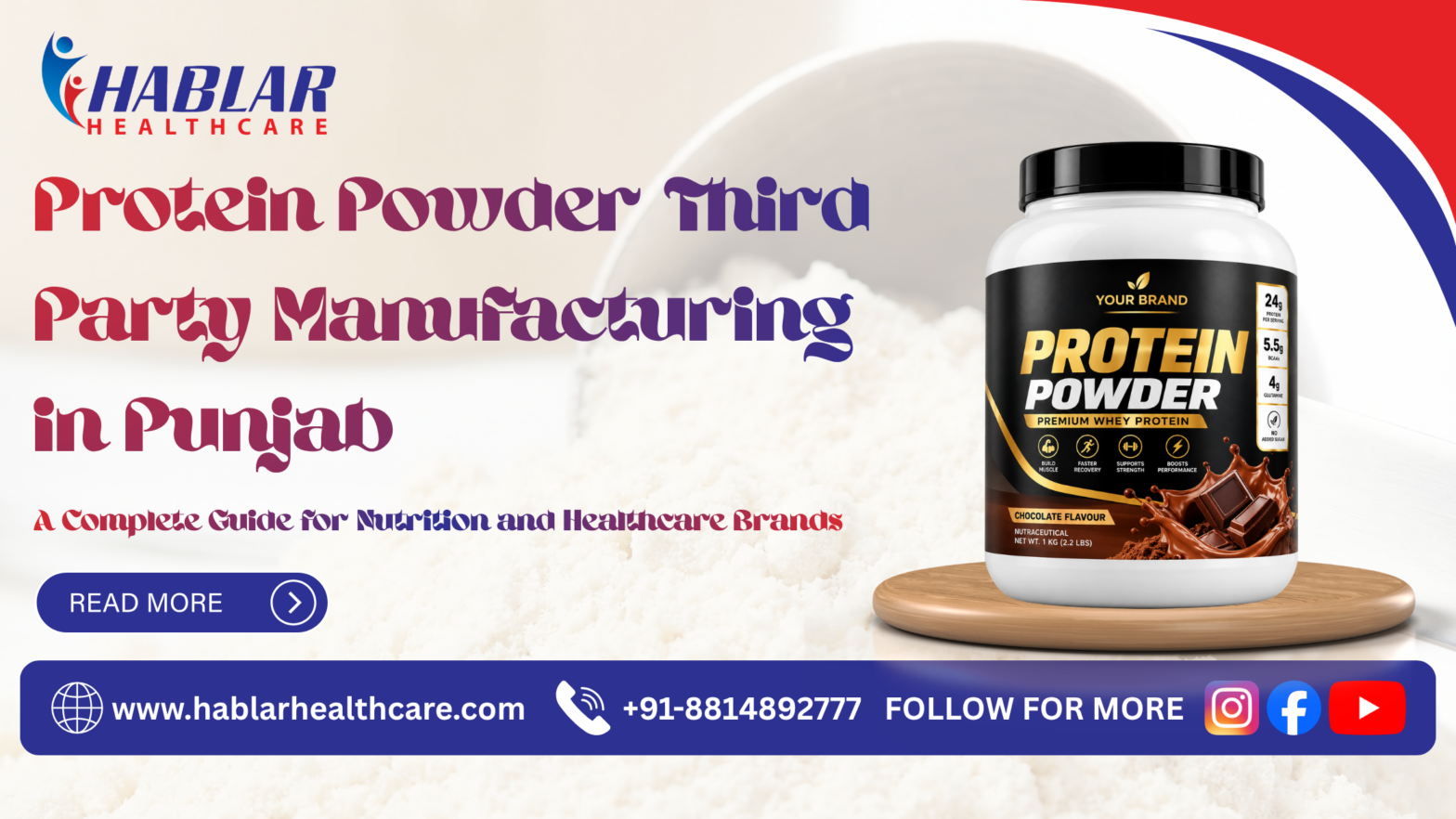
Punjab has a well-established business environment for healthcare, nutrition, fitness and wellness products. With growing interest in sports nutrition, protein supplements and healthier lifestyles, entrepreneurs, distributors and established businesses are exploring opportunities to launch their own protein powder brands. For businesses planning to enter this segment, protein powder third party manufacturing in Punjab offers a practical business model.
Instead of investing in an independent manufacturing facility, businesses can partner with an appropriately licensed manufacturer to develop and produce products under their own brand name.
Whether you are planning to introduce whey protein, plant-based protein, mass gainer or daily nutrition powder, selecting the right manufacturing partner is essential. Product quality, formulation, ingredient selection, regulatory compliance, packaging and commercial terms all influence the success of a nutrition brand.
Hablar Healthcare works in the nutraceutical and healthcare product segment and welcomes enquiries from businesses exploring protein powder and private-label manufacturing opportunities.
In this guide, we will explain the third-party manufacturing process, different protein powder categories, important quality considerations, cost factors and how to start your own protein supplement brand in Punjab.
What Is Protein Powder Third Party Manufacturing?
Protein powder third-party manufacturing is a business arrangement in which a brand owner partners with an authorised manufacturing facility to produce protein supplements under the brand owner’s label.
Under this arrangement, the brand owner generally focuses on branding, marketing, distribution and sales, while the manufacturing partner handles the agreed production activities.
This model can help businesses avoid the substantial investment involved in setting up their own manufacturing infrastructure, purchasing machinery and recruiting production personnel.
For businesses operating in Punjab, third-party manufacturing can provide an opportunity to develop a nutrition product portfolio and serve customers across different markets.
Why Is Punjab a Promising Market for Protein Powder Brands?
Punjab offers business opportunities across fitness, healthcare, nutrition retail and distribution. As consumers become more interested in exercise, active lifestyles and nutritional products, businesses can explore different segments of the protein supplement market.
Some factors supporting this opportunity include:
1. Growing Fitness and Gym Culture
Fitness centres, gyms, sports academies and personal training facilities create potential channels for sports nutrition products. Consumers interested in strength training and fitness may explore protein supplements as part of their overall dietary plans.
2. Opportunities for Nutrition Distributors
Pharmaceutical distributors, supplement retailers and healthcare businesses can consider expanding their existing product portfolios with protein powders and other nutrition products.
3. Increasing Interest in Different Protein Sources
Consumers may have different preferences depending on their dietary requirements, product expectations and budgets. This creates opportunities for brands offering whey-based, plant-based and blended protein formulations.
4. Scope for Regional Brand Development
Businesses can develop their own brand identity, packaging and marketing strategy to reach customers in Punjab and other Indian markets.
5. Expansion Through Online and Offline Channels
Protein supplements can be marketed through suitable retail outlets, gyms, nutrition stores and online platforms, subject to applicable regulatory requirements.
Types of Protein Powder You Can Manufacture Under Your Brand
Choosing the right product category is an important first step when planning a protein supplement brand. Your selection should depend on your target audience, product positioning, formulation feasibility and market research.
1. Whey Protein Powder
Whey protein is widely used in sports and fitness nutrition. It is derived from milk and is available in different forms depending on processing and protein concentration.
Common formulation options include:
-
Whey Protein Concentrate
-
Whey Protein Isolate
-
Whey Protein Blends
-
Flavoured Whey Protein Powder
Brands can explore different flavour profiles, serving sizes and nutritional specifications depending on manufacturing capabilities.
2. Plant-Based Protein Powder
Plant-based protein powders are developed using protein ingredients obtained from plant sources. They may appeal to consumers who prefer non-dairy protein options.
Common ingredients include:
-
Pea Protein
-
Soy Protein
-
Rice Protein
-
Blended Plant Proteins
The ingredient selection should consider nutritional quality, allergen declarations, taste, texture and applicable food regulations.
3. Mass Gainer Powder
Mass gainer products generally combine protein with carbohydrate sources and may contain additional permitted nutrients.
These formulations are commonly positioned in the sports nutrition category. Businesses should carefully determine the nutritional composition, serving size and product claims before launching.
4. Daily Nutrition Protein Powder
Daily nutrition powders can be developed for adults looking for convenient nutritional support as part of their regular diet.
Depending on the formulation and regulatory category, these products may contain selected protein sources and other permitted nutritional ingredients.
5. Specialised Protein Formulations
Businesses may also explore customised protein blends containing selected vitamins, minerals or other permitted ingredients, depending on the intended product category and manufacturer’s technical capabilities.
Every formulation should undergo appropriate regulatory and technical review before commercial production.
Protein Powder Third Party Manufacturing Services in Punjab
A professional manufacturing arrangement should provide clarity at every stage, from initial product planning to finished-product supply.
Before selecting a pharma manufacturing partner in India, understand the services available and confirm which activities are included in the agreement.
1. Custom Formulation Development
Product formulation is one of the most important parts of protein powder manufacturing. The formulation should be designed around the intended product category, protein source, nutritional profile, flavour and target price.
2. Raw Material Selection
The quality of the finished product depends significantly on the raw materials used. Ask about ingredient specifications, supplier qualification, certificates of analysis and incoming material checks.
3. Manufacturing and Processing
The selected facility should have appropriate equipment, documented manufacturing procedures, trained personnel and suitable hygiene controls for the intended product.
4. Quality Testing and Documentation
A reliable quality system should include appropriate raw material checks, in-process controls and finished-product testing. Request relevant batch documentation and test reports.
5. Flavour Customisation
Depending on formulation feasibility, brands may explore different flavour options, sweetness levels and taste profiles.
6. Packaging and Labelling
Protein powder can be packed in suitable jars, tubs, pouches or other food-grade packaging formats. Packaging should protect the product from moisture and contamination and be appropriate for its intended shelf life.
7. Private Label Manufacturing
Private labelling allows businesses to introduce products under their own brand names through an agreed manufacturing arrangement. The responsibilities of the manufacturer and marketer should be clearly documented.
How to Choose the Right Protein Powder Manufacturer in Punjab
Selecting a manufacturing partner is not just about finding the lowest quotation. Your choice can influence product consistency, customer satisfaction, regulatory compliance and long-term business growth.
Before finalising a manufacturer, evaluate these important factors:
| Selection factor | What you should check |
|---|---|
| FSSAI licensing | Applicable licence and product category |
| Manufacturing experience | Experience with your preferred protein formulation |
| Raw material quality | Ingredient specifications and supplier records |
| Quality control | Testing procedures and batch documentation |
| Product customisation | Feasible ingredients, flavours and nutritional profiles |
| Packaging facilities | Jars, tubs, pouches and sealing options |
| Labelling support | Mandatory declarations and compliant product claims |
| Minimum order quantity | MOQ and production capacity |
| Commercial terms | Pricing, payment terms and delivery schedule |
| Customer support | Complaint handling and batch traceability |
A good manufacturing partner should be transparent about its production capabilities, quality systems, documentation and responsibilities.
Major Business Locations to Target in Punjab
Businesses planning to sell protein powder in Punjab can consider building their distribution networks around key commercial and urban markets.
1. Ludhiana
Ludhiana is an important commercial and industrial centre. Businesses can explore opportunities through nutrition stores, gyms, fitness centres, pharmacies and local distributors.
2. Chandigarh and Mohali
Chandigarh and Mohali offer potential access to fitness-oriented consumers, wellness retailers, gyms and healthcare-related businesses.
3. Jalandhar
Jalandhar has an established sports goods and fitness-related business ecosystem. Entrepreneurs can explore suitable distribution opportunities for sports nutrition products.
4. Amritsar
Amritsar provides opportunities to develop retail and distribution networks for health supplements and nutrition products.
5. Patiala
Businesses can explore local gyms, fitness studios, pharmacies and nutrition retailers as potential channels for protein supplement distribution.
6. Bathinda
Bathinda and surrounding areas may offer opportunities for businesses planning to expand their nutrition product distribution across southern Punjab.
A city-specific strategy can help businesses understand local competition, customer preferences, retail pricing and distribution requirements before launching.
Step-by-Step Process to Start Your Own Protein Powder Brand in Punjab
Starting a protein powder brand requires proper planning. The following steps can help you organise the process.
Step 1: Research your target market
Identify your intended customers, competing brands, preferred product categories and expected price range. Understand whether you want to target gym users, sports nutrition consumers, general wellness customers or retail distributors.
Step 2: Select your protein powder category
Decide whether you want to introduce whey protein, plant-based protein, mass gainer or another suitable nutritional powder.
Step 3: Finalise your product formulation
Discuss protein content, ingredient specifications, flavour, serving size and nutritional composition with your manufacturing partner.
Step 4: Finalise your brand identity
Select a brand name, logo, packaging style and product positioning. Your packaging should communicate the product information clearly and comply with applicable labelling requirements.
Step 5: Complete regulatory checks
Confirm the correct product category, ingredient permissions, licensing requirements and label declarations before commercial production.
Step 6: Review samples and quality documents
Evaluate product characteristics such as taste, texture, solubility and packaging suitability. Review the relevant specifications and testing documents.
Step 7: Confirm manufacturing and commercial terms
Discuss MOQ, product pricing, packaging costs, payment terms, production timelines and delivery arrangements.
Step 8: Develop your distribution strategy
Plan how you will reach retailers, gyms, fitness centres, pharmacies, distributors and online customers.
FSSAI Regulations and Quality Requirements for Protein Powder Manufacturing
Regulatory compliance is a critical part of launching a protein powder product in India. Depending on the formulation and intended use, a protein powder may fall under the applicable food product standards, health supplement or nutraceutical regulations, or another relevant category.
FSSAI’s framework for health supplements and nutraceuticals is governed by the Food Safety and Standards Regulations, 2016, along with applicable amendments and related requirements.
Before manufacturing and marketing your product, pay attention to the following:
-
FSSAI licensing: Confirm the appropriate licence or registration for the manufacturer and the brand owner or relabeller, as applicable.
-
Ingredient permissions: Check that the ingredients and their levels are permitted for the selected product category.
-
Product specifications: Establish suitable specifications for protein content, moisture, microbiological quality and other relevant parameters.
-
Raw material documentation: Maintain supplier details, specifications and certificates of analysis.
-
Finished product testing: Arrange appropriate testing and maintain batch-wise records.
-
Packaging and labelling: Ensure the packaging material is suitable and the label carries all mandatory declarations.
-
Advertising and claims: Avoid unsupported health, nutritional or performance claims.
-
Traceability: Maintain batch identification, complaint handling and recall procedures.
An important point for private-label businesses: FoSCoS provides guidance on the relevant business category for operators getting food products manufactured through third-party manufacturers, including the relabeller category. The exact licensing requirement should be confirmed for the business’s activities and product category.
Factors That Affect Protein Powder Third Party Manufacturing Cost in Punjab
The cost of protein powder manufacturing depends on the product specification and commercial arrangement. There is no universal price that applies to every formulation.
The following factors generally influence the quotation:
1. Type of protein: Whey concentrate, whey isolate and plant-based protein ingredients have different costs.
2. Protein content: The quantity and specification of protein in each serving affect the raw material requirement.
3. Additional ingredients: Flavours, sweeteners, vitamins, minerals and other permitted ingredients can influence the formulation cost.
4. Packaging selection: Jars, tubs, pouches, scoops, seals and printed labels contribute to the final price.
5. Order quantity: MOQ and production volume can affect the per-unit manufacturing cost.
6. Product testing: Testing requirements and documentation may add to the project cost.
7. Customisation: Special formulations, flavour development and customised packaging may involve additional charges.
To receive a useful quotation, share the product category, target protein content, pack size, estimated order quantity and packaging requirements.
Benefits of Private Label Protein Powder Manufacturing for Punjab Businesses
Private-label manufacturing offers businesses an opportunity to build their own product identity without establishing an independent manufacturing plant.
Some of its potential advantages include:
-
Reduced infrastructure investment: Avoid the cost of setting up a manufacturing facility.
-
Brand ownership: Develop your own brand name, logo and market identity.
-
Product flexibility: Explore different protein sources, flavours and packaging options.
-
Business expansion: Add nutrition products to an existing healthcare or wellness portfolio.
-
Market reach: Develop distribution across Punjab and other Indian states.
-
Scalable business planning: Start with a focused product range and expand based on market response.
However, private labelling does not eliminate regulatory responsibilities. The agreement should clearly define the responsibilities of the manufacturer, brand owner and other relevant food business operators.
Why Consider Hablar Healthcare for Protein Powder Manufacturing?
Hablar Healthcare works in the nutraceutical and healthcare product segment. Businesses interested in launching protein powder products can contact the company to discuss their requirements and explore suitable manufacturing possibilities.
For a business planning to enter the Punjab market, the initial discussion should cover:
-
Preferred protein powder category
-
Target nutritional composition
-
Whey-based or plant-based formulation requirements
-
Flavour and packaging preferences
-
Expected order quantity
-
Private-label and branding requirements
-
Applicable regulatory documentation
-
Commercial terms and production timelines
The actual product range, manufacturing scope, MOQ, certifications and availability should be verified for the specific project before placing an order.
Frequently Asked Questions (FAQs)
1. What is protein powder third-party manufacturing in Punjab?
It is a business arrangement in which a brand owner partners with an appropriately licensed manufacturing facility to produce protein powder under its own brand name, subject to applicable regulatory requirements.
2. Can I start my own protein powder brand in Punjab?
Yes. You can explore private-label manufacturing by selecting a product category, finalising a suitable formulation, completing the required regulatory formalities and planning your branding and distribution.
3. Which protein powders can be manufactured through third-party manufacturing?
Depending on the manufacturing facility and regulatory requirements, options may include whey protein, plant-based protein, mass gainers and other nutritional powder formulations.
4. Is FSSAI licensing required for protein powder manufacturing?
Yes, applicable FSSAI licensing or registration is required for relevant food business activities. The exact requirements depend on the product category and the activities performed by the manufacturer and marketer.
5. Can I manufacture whey protein under my own brand name?
Yes, private-label whey protein manufacturing may be possible through a suitable authorised manufacturer. The formulation, product specifications and regulatory responsibilities should be confirmed before production.
6. What is the minimum order quantity for protein powder manufacturing?
MOQ depends on the manufacturer, formulation, packaging material and order requirements. You should request a product-specific quotation before finalising your business plan.
7. How much does protein powder third-party manufacturing cost in Punjab?
The cost depends on the protein source, nutritional composition, ingredients, packaging, order quantity and testing requirements. A customised quotation is necessary to determine the actual cost.
8. Can I customise the flavour of my protein powder?
Yes, flavour customisation may be possible depending on the formulation and manufacturing capabilities. Common preferences include chocolate, vanilla and other suitable flavours.
9. What packaging options are available for protein powder?
Common packaging options include plastic jars, tubs, stand-up pouches and other suitable food-grade packaging formats. The packaging should protect the product from moisture and maintain its quality.
10. Can startups choose third-party protein powder manufacturing?
Yes. Third-party pharma manufacturing can help startups enter the nutrition market without investing in their own production facility. Startups should also plan for branding, licensing, marketing, testing and distribution expenses.
Conclusion
The growing interest in fitness, sports nutrition and nutritional supplements is creating opportunities for businesses looking to enter the protein powder market in Punjab. For entrepreneurs, distributors, healthcare companies and established nutrition brands, third-party manufacturing provides a practical way to develop their own products without investing in an independent manufacturing facility.
However, building a successful protein supplement brand requires more than selecting a manufacturer. It involves understanding customer requirements, choosing suitable ingredients, developing an appropriate formulation, maintaining product quality, following FSSAI regulations and creating an effective distribution strategy.
Whether you are planning to launch whey protein, plant-based protein, mass gainer or daily nutrition powder, working with a suitable manufacturing partner can help you organise the product development and manufacturing process.
Hablar Healthcare welcomes business enquiries from entrepreneurs, distributors and companies interested in protein powder and private-label nutraceutical manufacturing. Contact the team at +91-8814892777 to discuss your requirements and explore the possibilities of developing your own protein supplement brand in Punjab.