
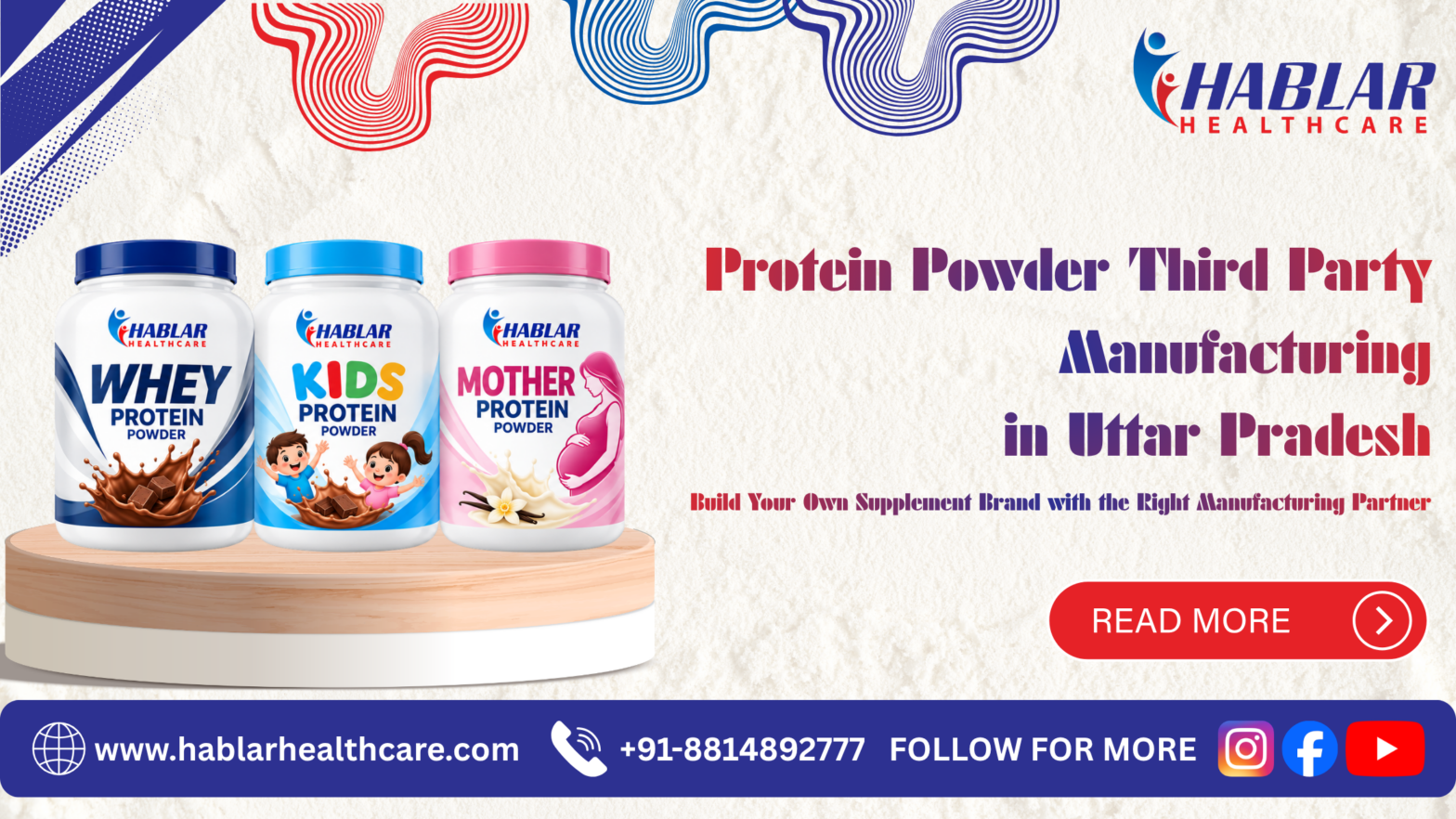
The health and nutrition industry in India is creating new opportunities for entrepreneurs, pharmaceutical distributors, fitness businesses, and nutraceutical companies. For entrepreneurs who want to enter this industry without establishing their own production facility, protein powder third party manufacturing in Uttar Pradesh can be a practical business model.
Consumers are becoming more interested in fitness, balanced nutrition, active lifestyles, and convenient sources of dietary protein. As a result, protein powder has become an important category in the nutritional supplement market.
Uttar Pradesh offers considerable business opportunities for companies interested in this segment. From Lucknow, Kanpur, Noida, and Ghaziabad to Agra, Varanasi, Meerut, Prayagraj, Gorakhpur, and Bareilly, businesses can explore the growing market for nutritional and sports supplement products.
It allows companies to develop products under their own brand name while outsourcing manufacturing to a suitable production partner.
Hablar Healthcare works in the healthcare and nutraceutical business segment and can be approached by businesses exploring protein powder and nutritional supplement manufacturing opportunities. With proper product planning, quality-focused manufacturing, compliant packaging, and an effective distribution strategy, a business can work towards building a recognised supplement brand.
What Is Protein Powder Third Party Manufacturing?
Protein powder third party manufacturing is a business arrangement in which a brand owner hires an external manufacturer to produce protein-based nutritional supplements under an agreed brand name and product specification.
In this arrangement, the brand owner generally manages business development, marketing, distribution, and customer relationships. The manufacturing partner undertakes the production activities covered by the agreement, including formulation-related work, ingredient procurement, processing, quality checks, and packaging, depending on its capabilities and the agreed scope.
For example, a pharmaceutical distributor in Lucknow may want to launch a whey protein supplement under a new brand. Instead of investing in machinery, production space, and a manufacturing team, the distributor can approach a suitable third-party manufacturer.
After finalising the product formulation, packaging, quantity, commercial terms, and regulatory requirements, the product can be manufactured and marketed under the agreed brand arrangement.
This model can help new businesses enter the nutritional supplement market while concentrating on sales, brand positioning, and distribution.
Why Is Uttar Pradesh a Promising Market for Protein Powder Brands?
Uttar Pradesh has a large and diverse consumer market, with established commercial centres, developing urban areas, educational institutions, fitness facilities, pharmacies, and retail networks.
The state’s varied customer base creates opportunities for businesses offering nutritional products at different price points.
Several factors make the protein supplement category worth exploring:
1. Increasing Interest in Fitness and Nutrition
Gym memberships, strength training, sports activities, and general fitness awareness are encouraging consumers to pay more attention to their nutritional requirements.
Protein supplements are one of the product categories that fitness-conscious customers may consider as part of their overall dietary routine.
2. Opportunities for Pharmaceutical Distributors
Pharmaceutical distributors and healthcare traders already have experience in product distribution, retailer relationships, and market development.
Adding nutritional supplements to an existing portfolio can help them explore another business category, provided they understand the applicable regulatory and marketing requirements.
3. Growth of Fitness and Wellness Retail
Fitness centres, supplement stores, pharmacies, and wellness retailers can provide distribution opportunities for properly positioned protein powder brands.
Businesses can develop products according to customer preferences, local competition, and their chosen price segment.
4. Scope for Private-Label Supplement Brands
Entrepreneurs increasingly look for ways to introduce products under their own brand identities. Third-party manufacturing can make this possible without requiring them to establish a complete production facility.
5. Opportunities Beyond Major Cities
The market is not limited to metropolitan areas. Distributors and retailers in smaller cities and towns can also evaluate the demand for nutritional supplements through local market research.
Types of Protein Powder Products You Can Launch Under Your Brand
Selecting the right product category is an important step in developing a protein supplement business. Different customers have different nutritional preferences, budgets, and product expectations.
A business should select its products after considering the target audience, formulation requirements, ingredient availability, manufacturing capabilities, and applicable regulations.
1. Whey Protein Concentrate
Whey protein concentrate is a widely recognised ingredient in sports nutrition products. It is derived from milk and is commonly used in protein powders for fitness enthusiasts.
Brands can explore different formulations depending on the protein content, flavour, nutritional profile, and intended price range.
2. Whey Protein Isolate
Whey protein isolate is a more concentrated form of whey protein and generally contains a higher proportion of protein than standard whey concentrate.
It may be considered for premium sports nutrition products. The final formulation and declared nutritional values should be supported by suitable specifications and testing.
3. Plant-Based Protein Powder
Plant-based protein products are an option for consumers looking for non-dairy protein sources.
Depending on the formulation, suitable ingredients may include:
- Pea protein
- Soy protein
- Rice protein
- Other permitted plant-derived protein ingredients
The protein source should be selected according to nutritional requirements, taste, texture, ingredient compatibility, and regulatory suitability.
4. Mass Gainer Powder
Mass gainer products are generally developed using a combination of protein, carbohydrates, and other permitted ingredients.
These products are positioned for consumers looking for higher-calorie nutritional supplementation. Formulation decisions should consider serving size, nutritional composition, taste, and the intended customer segment.
5. Protein Blends
Protein blends combine two or more protein sources to achieve a particular nutritional or commercial specification.
For example, a formulation may combine different permitted dairy or plant-based protein ingredients. The choice depends on the product’s intended nutritional profile and target price.
6. Specialised Nutritional Protein Powders
Businesses may also explore protein powders developed for specific nutritional positioning, subject to ingredient permissions and applicable product-category requirements.
Such products need careful formulation, testing, and labelling. Any special nutritional or health-related claim must be supported and legally permissible.
Why Choose Third Party Protein Powder Manufacturing?
Establishing a protein powder manufacturing facility requires investment in infrastructure, equipment, raw materials, technical staff, quality systems, and regulatory arrangements.
For many businesses, outsourcing production can be a more manageable alternative.
Reduced Manufacturing Infrastructure Investment
A brand owner can avoid the substantial investment involved in setting up a dedicated manufacturing plant. This allows more resources to be directed towards product development, marketing, distribution, and business expansion.
Opportunity to Build Your Own Brand
Third-party manufacturing can help entrepreneurs introduce protein powder products under their own brand names, subject to the relevant licensing, labelling, and contractual requirements.
Flexibility in Product Selection
Businesses can evaluate different protein categories, flavours, packaging formats, and product specifications based on their target customers and commercial plans.
Focus on Sales and Distribution
Instead of managing daily production activities, the brand owner can concentrate on building relationships with pharmacies, gyms, fitness retailers, wholesalers, and distributors.
Scope for Business Expansion
Once the initial product gains market acceptance, businesses can consider expanding their range with additional protein formulations and other nutraceutical products.
Support From an Experienced Manufacturing Partner
A suitable manufacturer may provide assistance with formulation discussions, ingredient selection, production planning, packaging coordination, and quality documentation.
The actual services available should always be confirmed before entering into a manufacturing agreement.
Protein Powder Third Party Manufacturing in Major Cities of Uttar Pradesh
Uttar Pradesh has several important commercial and distribution centres where businesses can explore the nutritional supplement market.
Protein Powder Manufacturing Opportunities in Lucknow
Lucknow is an important commercial centre and the capital of Uttar Pradesh. Pharmaceutical distributors, pharmacy owners, supplement retailers, and fitness businesses can evaluate opportunities in the protein powder segment.
Businesses can explore whey protein, plant-based protein, and other nutritional powder categories according to their customer base.
Protein Powder Manufacturing Opportunities in Noida
Noida has a strong presence of corporate professionals, fitness centres, modern retail outlets, and online businesses.
Entrepreneurs in this region can explore premium nutritional supplements, private-label protein products, and digital-first supplement brands.
Protein Powder Manufacturing Opportunities in Ghaziabad
Ghaziabad provides opportunities for distributors, wholesalers, retailers, and healthcare businesses interested in expanding their nutritional supplement portfolios.
A well-planned distribution network can help brands reach customers across different market segments.
Protein Powder Manufacturing Opportunities in Kanpur
Kanpur is an established commercial and industrial city. Businesses dealing in pharmaceutical and healthcare products can consider adding protein powder supplements to their existing distribution activities.
Protein Powder Manufacturing Opportunities in Agra
Agra has a diverse retail and commercial market. Local entrepreneurs and distributors can explore nutritional products through pharmacies, gyms, supplement stores, and other relevant sales channels.
Protein Powder Manufacturing Opportunities in Varanasi
Varanasi serves as an important commercial centre for surrounding areas. Businesses can evaluate opportunities for distributing nutritional supplements through local retail and healthcare networks.
Protein Powder Manufacturing Opportunities in Meerut
Meerut has a recognised sports and fitness-related business environment. This makes it a relevant location for entrepreneurs exploring sports nutrition and protein supplement products.
Protein Powder Manufacturing Opportunities in Prayagraj
Distributors and healthcare retailers in Prayagraj can explore protein-based nutritional products as part of a wider health supplement portfolio.
Protein Powder Manufacturing Opportunities in Gorakhpur
Gorakhpur and its surrounding markets offer opportunities for distributors and retailers interested in introducing nutritional supplement products.
Other Important Markets
Businesses in Bareilly, Aligarh, Moradabad, Jhansi, Mathura, Saharanpur, Ayodhya, and other cities can also assess the potential for protein powder distribution and private-label supplement brands.
A state-wide strategy should consider local competition, customer purchasing power, transport costs, retail availability, and demand before deciding on production quantities.
How to Select the Best Protein Powder Third Party Manufacturer
Choosing a manufacturing partner is one of the most important decisions when launching a protein supplement brand.
A competitive quotation is useful, but it should never be the only factor. Product quality, regulatory compliance, documentation, manufacturing capability, and communication should also be evaluated.
1. Verify Applicable Manufacturing Licences
Check whether the manufacturer has the appropriate licence for the product category and manufacturing activity.
For protein powders regulated under the FSSAI framework, verify the relevant FSSAI licence and whether the proposed formulation and ingredients are permitted for the intended category.
Do not assume that a licence for one type of supplement automatically covers every protein powder formulation.
2. Evaluate Raw Material Quality
The quality of a finished protein powder depends significantly on the ingredients used.
Discuss the following points with the manufacturer:
- Protein source and ingredient grade
- Raw material specifications
- Supplier qualification
- Ingredient traceability
- Allergen information
- Relevant quality and safety testing
3. Understand the Manufacturing Process
Ask about the manufacturer’s production infrastructure, blending process, hygiene practices, packaging facilities, and batch documentation.
The manufacturer should be able to explain the processes relevant to your product.
4. Check Quality Testing Facilities
Protein powder products should be evaluated against their approved specifications and applicable quality requirements.
Depending on the formulation, relevant testing may include:
- Protein content
- Moisture content
- Microbiological parameters
- Heavy metals, where applicable
- Other product-specific quality parameters
Ask for suitable test reports and understand how finished-batch quality is verified.
5. Discuss Customisation Options
If you want to create a distinctive product, discuss formulation possibilities with the manufacturer.
Customisation may involve protein sources, nutritional composition, flavour, sweetness, serving size, and packaging.
All proposed ingredients and product claims must meet the applicable regulatory requirements.
6. Compare MOQ and Pricing
The minimum order quantity can differ from one product to another.
It may depend on:
- Type of protein ingredient
- Formulation complexity
- Flavour selection
- Packaging material
- Jar or pouch size
- Printing requirements
- Production batch size
Request a detailed quotation before making a commercial commitment.
7. Review Documentation and Communication
A reliable manufacturer should clearly explain the manufacturing arrangement, product specifications, quality responsibilities, payment terms, and expected production schedule.
A written agreement is recommended to define the responsibilities of the manufacturer and brand owner.
Step-by-Step Process to Launch Your Own Protein Powder Brand
Launching a protein powder brand becomes easier when the process is planned systematically.
Step 1: Identify Your Target Customers
Decide whom you want to serve.
Your target customers may include:
- Gym owners and fitness enthusiasts
- Sports nutrition retailers
- Pharmaceutical distributors
- Pharmacy owners
- Nutritional supplement wholesalers
- Online supplement businesses
- Wellness and health product retailers
Understanding the customer helps determine product positioning and pricing.
Step 2: Select Your Protein Powder Category
Choose the product that best suits your market research.
For a new brand, it may be practical to start with one or two carefully selected products rather than introducing a large portfolio immediately.
Step 3: Finalise the Product Formulation
Discuss the protein source, nutritional composition, flavour, serving size, ingredient specifications, and product positioning with the manufacturer.
Make sure the formulation is suitable for the intended regulatory category.
Step 4: Decide Your Brand Name and Packaging
Select a distinctive brand name and develop suitable packaging artwork.
Protein powder packaging should be designed to protect the product from moisture and other environmental factors. It should also provide all mandatory product information.
Step 5: Complete Regulatory Review
Review the applicable licensing, ingredient permissions, nutritional declarations, label requirements, and claims before production.
Do not wait until the packaging is printed to begin regulatory verification.
Step 6: Finalise Commercial Terms
Confirm the MOQ, product cost, packaging charges, testing requirements, taxes, payment terms, and production timeline.
Keep the agreed specifications and responsibilities documented.
Step 7: Approve Samples and Production Details
Where sampling is part of the arrangement, evaluate the product’s taste, texture, appearance, solubility, and other relevant characteristics before approving the final specifications.
Step 8: Plan Distribution and Marketing
Develop a practical sales strategy for pharmacies, gyms, supplement retailers, distributors, and online platforms.
Plan your inventory according to realistic sales expectations rather than ordering excessive quantities at the beginning.
FSSAI Compliance and Quality Requirements for Protein Powder
Regulatory compliance is a critical part of protein powder third-party manufacturing. A product’s formulation, ingredients, nutritional declarations, claims, packaging, and manufacturing arrangement must be evaluated under the applicable food safety regulations.
For businesses planning to introduce protein supplements in Uttar Pradesh, the following areas deserve particular attention.
Product Category and Ingredient Permissions
Confirm the correct FSSAI product category and check whether each ingredient is permitted for the proposed formulation.
If a formulation contains an ingredient that is not covered under the applicable standards or permitted categories, its regulatory status must be evaluated before commercial production.
FSSAI Licensing
The manufacturer must hold the appropriate licence for the relevant manufacturing activity and product category.
The brand owner, marketer, distributor, or relabeller must also assess the licence or registration applicable to its own business activity.
The exact requirement depends on the role of each business and the nature of the product.
Nutritional Information
Nutritional values declared on the packaging should accurately reflect the product composition and applicable labelling rules.
Protein content and other declared nutritional parameters should be supported by appropriate formulation records and testing.
Labelling and Packaging
Before printing any label, check the mandatory declarations applicable to the product. These may include:
- Name of the food
- Ingredient list
- Nutritional information
- Allergen declaration
- Net quantity
- Batch or lot identification
- Date marking
- Storage instructions
- Manufacturer’s name and address
- Applicable FSSAI licence details
- Marketer or brand owner details, where required
- Customer care information
- Usage instructions, where applicable
The final label should be reviewed against current regulatory requirements.
Responsible Product Claims
Claims such as high protein, source of protein, sugar-free, weight gain, muscle building, and other nutritional or health-related statements should only be used when the product meets the relevant legal conditions.
Avoid exaggerated claims, guaranteed results, or statements suggesting that a food supplement can treat or cure a disease.
Batch Testing and Traceability
Maintain suitable records for raw materials, production batches, testing, packaging, and distribution.
Batch traceability and quality documentation can help businesses investigate complaints, monitor consistency, and manage product-related issues.
Packaging Options for Protein Powder Products
Packaging is an important part of protein powder manufacturing because it affects product protection, storage, transportation, and brand presentation.
The suitable packaging format depends on the formulation, pack size, target customer, and commercial requirements.
Protein Powder Jars
Jars are commonly considered for retail-facing protein supplement products. They provide a convenient format for products sold through fitness stores, pharmacies, and online platforms.
Protein Powder Pouches
Pouches can be explored for different pack sizes and may suit brands looking for flexible packaging options.
The selected material should provide suitable protection against moisture and other factors that may affect product quality.
Protein Powder Sachets
Sachets may be useful for sample packs, trial quantities, and selected single-serving products.
They can also help businesses introduce a product to customers before encouraging them to purchase a larger pack.
Bulk Packaging
Bulk packaging may be suitable for institutional buyers or specific B2B requirements, subject to the manufacturer’s capabilities and applicable labelling and packaging requirements.
How to Build a Successful Protein Powder Brand in Uttar Pradesh
Manufacturing a product is only the beginning. A successful supplement business also requires market understanding, distribution planning, customer trust, and consistent quality.
Start With a Clear Product Positioning
Decide whether your brand will focus on affordable protein supplements, premium whey protein, plant-based products, or a broader nutritional range.
A clear product identity makes marketing and customer communication easier.
Develop a Strong Distributor Network
Build relationships with pharmaceutical distributors, supplement wholesalers, pharmacy owners, gyms, and fitness retailers.
Choose distribution partners who understand the product and can communicate its specifications responsibly.
Focus on Product Quality
Customer confidence depends on product consistency. Work with a manufacturer that follows suitable quality systems and provides relevant documentation.
Create Informative Digital Content
Use your website and social media platforms to explain product ingredients, nutritional information, serving instructions, and storage recommendations.
Educational content can help customers understand the product without relying on exaggerated promotional claims.
Maintain Competitive Pricing
Calculate the complete product cost, including manufacturing, packaging, transportation, taxes, distributor margins, retailer margins, and marketing expenses.
Pricing should support business sustainability while remaining appropriate for the intended customer segment.
Expand Your Portfolio Gradually
After understanding customer response to your initial products, consider introducing additional flavours, pack sizes, or other nutritional supplement categories.
Gradual expansion can make inventory and cash-flow management easier.
Common Mistakes to Avoid in Protein Powder Third Party Manufacturing
New brand owners sometimes focus heavily on product price and overlook important manufacturing and regulatory details.
Avoid these mistakes when selecting a third-party manufacturing partner:
- Choosing a manufacturer without checking the applicable licence.
- Selecting ingredients without verifying their regulatory status.
- Ignoring raw material specifications and testing.
- Making unsupported protein-content or health claims.
- Printing packaging without a proper label review.
- Selecting a product only because its quotation is inexpensive.
- Not confirming the MOQ and additional charges in writing.
- Ordering large quantities without evaluating market demand.
- Failing to define manufacturing and quality responsibilities.
- Ignoring batch traceability and customer complaint procedures.
A planned approach can help reduce commercial risks and support long-term brand development.
Why Consider Hablar Healthcare for Protein Powder Manufacturing?
Finding a suitable manufacturing partner is an important step for any entrepreneur planning to launch a protein supplement brand.
Hablar Healthcare operates in the healthcare and nutraceutical business segment and can be approached by distributors, entrepreneurs, and companies interested in exploring protein powder and health supplement manufacturing opportunities.
Businesses from Uttar Pradesh can discuss their product requirements and evaluate whether the available manufacturing arrangements match their commercial and regulatory needs.
Before finalising a project, it is useful to discuss:
- Available protein powder categories
- Whey and plant-based protein options
- Formulation and ingredient specifications
- Flavour and packaging requirements
- Product customisation possibilities
- Minimum order quantity
- Manufacturing and testing documentation
- Applicable regulatory licences
- Pricing and production timelines
The most suitable manufacturing arrangement is one that matches the brand’s product requirements, quality expectations, budget, and business plans.
Hablar Healthcare aims to support businesses exploring opportunities in the nutraceutical and nutritional supplement segment through professional business coordination and product-focused discussions.
Future Scope of Protein Powder Third Party Manufacturing in Uttar Pradesh
The nutritional supplement industry continues to offer opportunities for entrepreneurs who understand changing consumer preferences and develop products responsibly.
Uttar Pradesh’s large consumer base and diverse commercial markets provide an opportunity for businesses to explore protein-based nutritional products across different customer segments.
The category can be considered by established pharmaceutical distributors, healthcare companies, fitness retailers, supplement entrepreneurs, and new private-label brand owners.
However, sustainable business growth requires more than simply introducing a new product. Companies need to understand their target market, choose suitable formulations, maintain product quality, follow regulatory requirements, and build a dependable distribution network.
Third-party manufacturing can help businesses explore this opportunity without independently establishing a complete production facility. With careful planning and a suitable manufacturing partner, entrepreneurs can work towards developing a competitive protein supplement brand.
Conclusion
Protein powder third party manufacturing in Uttar Pradesh presents an opportunity for entrepreneurs, pharmaceutical distributors, nutraceutical companies, and fitness businesses looking to enter the nutritional supplement market.
By choosing a suitable manufacturing partner, businesses can explore whey protein, plant-based protein, mass gainer, and other protein-based nutritional products under their own brand identity.
Before starting, it is important to verify manufacturing licences, ingredient permissions, product specifications, quality-testing arrangements, packaging requirements, minimum order quantities, and commercial terms.
Hablar Healthcare can be approached by businesses interested in exploring protein powder and nutraceutical manufacturing opportunities. A combination of quality-focused manufacturing, regulatory compliance, effective branding, and a strong distribution strategy can help businesses build a sustainable presence in Uttar Pradesh.
Frequently Asked Questions (FAQs)
1. What is protein powder third party manufacturing in Uttar Pradesh?
Protein powder third-party manufacturing is a business arrangement in which a company outsources the production of protein supplements to a suitable manufacturer. The products are manufactured under the agreed brand name and specifications, while the brand owner focuses on marketing and distribution.
2. Can I start my own protein powder brand in Uttar Pradesh?
Yes. Entrepreneurs, distributors, and healthcare businesses can explore launching their own protein powder brands by working with a suitable third-party manufacturer and meeting the applicable FSSAI and business requirements.
3. Which protein powder products can be manufactured through third-party manufacturing?
Depending on the manufacturer’s capabilities and applicable regulatory permissions, options may include whey protein concentrate, whey protein isolate, plant-based protein, mass gainers, and customised protein blends.
4. Is third-party protein powder manufacturing suitable for startups?
It can be suitable for startups because it may reduce the need to invest in manufacturing infrastructure. However, startups should consider the minimum order quantity, product cost, regulatory requirements, working capital, and marketing expenses before launching.
5. What is the minimum order quantity for protein powder manufacturing?
The MOQ varies according to the protein source, formulation, flavour, packaging material, and production requirements. It should be confirmed directly with the selected manufacturing partner.
6. Can I manufacture protein powder under my own brand name?
Yes. Third-party or private-label arrangements may allow a company to sell products under its own brand name, subject to the applicable licensing, labelling, contractual, and regulatory requirements.
7. What licences should a protein powder manufacturer have?
The manufacturer should hold the appropriate FSSAI licence for its manufacturing activity and the relevant product category. The brand owner or marketer should also assess the licence or registration applicable to its own business activity.
8. Is FSSAI compliance necessary for protein powder products?
Yes. Protein powders regulated as food or health supplements must comply with applicable FSSAI requirements relating to ingredients, product categories, licensing, nutritional information, labelling, and claims.
9. Can protein powder formulations be customised?
Customisation may be possible depending on the manufacturer’s capabilities, ingredient availability, formulation requirements, and regulatory permissions. Brands can discuss protein sources, flavour, nutritional composition, serving size, and packaging options.
10. Which cities in Uttar Pradesh offer opportunities for protein powder businesses?
Lucknow, Noida, Ghaziabad, Kanpur, Agra, Varanasi, Meerut, Prayagraj, Gorakhpur, Bareilly, Aligarh, and Moradabad are among the cities where businesses can explore protein supplement distribution opportunities.
Hablar Healthcare – Your Business Contact for Protein Powder and Nutraceutical Manufacturing Opportunities.